

How to Choose the Right Industrial Pillar Drill for Your Workshop or Production Application
Choosing an industrial pillar drill based only on its quoted maximum drilling capacity can result in selecting the wrong machine. A 25 mm, 40 mm or 50 mm drilling capacity is useful information, but it does not tell the whole story. The correct machine depends on the material being machined, the largest holes and threads required, spindle speed and torque requirements, and how intensively the machine will be used. For production applications, the question also extends beyond the basic pillar drill. Automatic drilling feeds, tapping cycles, programmable controls, multi-spindle heads and gang drilling systems can significantly increase productivity. The starting point should therefore be the work the machine is expected to perform.
1. What Drilling Capacity Do You Require?
The first consideration is the maximum diameter hole that needs to be drilled. Industrial pillar drills are normally specified with a maximum drilling capacity in steel. This provides a useful basis for comparing machines, but the quoted capacity should not be considered in isolation. Consider:
- Maximum hole diameter
- Material being drilled
- Hole depth
- Number of holes
- Tooling being used
- Required production rate
- Whether drilling is continuous or intermittent
A machine used occasionally for maintenance work has very different requirements from one repeatedly drilling near its maximum capacity throughout a production shift.
2. What Tapping Capacity Do You Require?
If the machine will also be used for tapping, the maximum required thread size should be established separately from the drilling capacity. Tapping can impose substantial torque requirements on the spindle and drive system. The required torque is affected by thread diameter, material, thread pitch, tap geometry, lubrication and cutting conditions. For this reason, industrial drills are commonly specified with both a maximum drilling capacity and a maximum tapping capacity. A machine capable of drilling the required hole diameter should not automatically be assumed to have the required tapping capacity.
3. Material Matters
The material being machined has a direct effect on the load imposed on the machine. Drilling and tapping requirements vary considerably between materials such as:
- Mild steel
- Stainless steel
- Aluminium
- Cast iron
- Tool steels
- Engineering plastics
- Other alloys
Material strength, toughness and machinability influence the appropriate cutting speed, feed and torque requirement. Consequently, two applications requiring the same diameter hole can place quite different demands on the drilling machine. When selecting a pillar drill, the material should therefore be considered alongside the maximum drilling and tapping sizes.
4. Understanding Torque, Speed and Motor Power
Drilling capacity ultimately depends upon the ability of the machine to rotate the cutting tool at the required speed while providing sufficient torque at the spindle. The principal factors influencing the cutting requirement include:
- Hole diameter
- Material
- Cutting speed
- Feed rate
- Tool geometry
- Tool condition
- Hole depth
- Tapping requirements
As drilling diameter increases, the appropriate spindle speed will generally decrease while the torque requirement becomes increasingly important. This is why simply comparing motor power figures can be misleading. Cutting requirement → spindle speed and torque → motor power and drive system A correctly selected industrial drill must provide the necessary combination of speed, torque and power at the spindle for the intended work.
5. Spindle Speed Range and Control
Different tool diameters and materials require different cutting speeds. A useful industrial pillar drill therefore needs a spindle speed range appropriate to the work being undertaken. Machines may use:
- Stepped V-belt speed changes
- Gearbox speed changes
- Variable-speed drives
- Electronic speed control
- Combinations of gears and electronic speed control
Smaller diameter drilling generally requires higher spindle speeds, while larger diameter drilling and tapping normally require lower speeds with greater available torque. A workshop handling a wide variety of materials and hole sizes will generally benefit from a broad and easily adjustable speed range.
6. V-Belt or Geared Pillar Drill?
V-Belt Pillar Drills
V-belt machines are well suited to lighter and general-purpose drilling applications. They are mechanically simple and can provide a wide selection of spindle speeds, although changing between stepped speeds normally requires repositioning the drive belts. For maintenance departments, fabrication workshops and general drilling, a quality industrial V-belt machine can be entirely appropriate.
Geared-Head Pillar Drills
Geared-head machines are generally better suited to heavier drilling, larger diameters, tapping and more intensive production work. The gearbox provides positive power transmission and makes it practical to provide the lower spindle speeds and higher torque required for heavier cutting operations. For applications regularly approaching the machine’s drilling or tapping capacity, a geared machine will normally be the more appropriate choice.
7. How Often Will the Pillar Drill Be Used?
Maximum capacity is only part of machine selection. The expected duty cycle is equally important.
Maintenance / Occasional Use
The drill is used intermittently for repair, maintenance and general engineering work. Manual feed and a conventional industrial V-belt or geared machine may be sufficient.
General Workshop Use
The machine is used regularly for a variety of drilling and occasional tapping operations. Greater consideration should be given to motor power, speed range, machine rigidity, table capacity and ease of adjustment.
Standard Production
The drill performs repeated operations on similar components. Automatic spindle feed, tapping functions, coolant equipment and production fixtures can provide substantial improvements in productivity and consistency.
High-Volume Production
At higher production volumes, simply selecting a larger pillar drill may no longer be the best solution. Programmable drilling cycles, multi-spindle heads, gang drills and dedicated automated drilling systems should then be considered.
8. Manual or Automatic Drilling Feed?
With a manual-feed pillar drill, the operator controls spindle movement using the feed handle. This provides flexibility for maintenance work and applications involving frequently changing components. With an automatic-feed machine, the spindle feed can be engaged mechanically or electrically so that the drill advances at a controlled feed rate. Automatic feed provides several advantages in repetitive drilling:
- More consistent feed rates
- Reduced operator effort
- Improved repeatability
- Better control of cutting conditions
- Increased production capability
For production drilling, automatic feed can be as important as the machine’s nominal drilling capacity.

9. Production Drilling Options
Once drilling becomes a repetitive production process, there are several ways of increasing productivity beyond a conventional manually operated pillar drill.
Automatic Feed
Automatic drilling feed allows the machine to perform the cutting stroke at a controlled feed rate. The operator can concentrate on component loading and unloading rather than manually controlling the complete drilling operation.
Automatic Tapping and Reverse
Where threads are repeatedly produced, machines equipped for tapping can control spindle reversal as part of the tapping operation. This reduces operator intervention compared with manually reversing the spindle for every thread.
Programmable Drilling Cycles
More advanced drilling machines can incorporate digital controls and programmable operating cycles. Depending upon the machine configuration, these can provide control over parameters such as drilling depth, spindle movement, tapping cycles and repetitive machining sequences. For repeat production, this allows the drilling operation to become a controlled machine cycle rather than relying entirely on operator technique.

Multi-Spindle Drilling Heads
Where a component requires several holes, drilling each hole individually can become the limiting factor in production. A multi-spindle drilling head allows several tools to operate simultaneously. Multiple holes can therefore be produced during a single machine cycle rather than requiring the component to be repositioned for every hole. Multi-spindle heads can be particularly effective where the same hole pattern is repeatedly produced on a large quantity of components.

Gang Drilling Machines
A gang drill uses multiple drilling heads or stations arranged along a common working area. Rather than performing every operation on a single spindle, a component can progress through a sequence of operations. For example: Drilling → Countersinking → Tapping This arrangement can substantially increase throughput where components require several different machining operations.
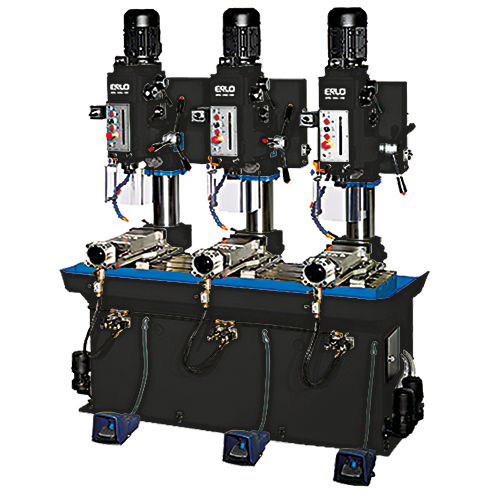
Automated Drilling Heads
For higher-volume or specialised applications, dedicated drilling heads can be incorporated into fixtures, automated machinery or purpose-built production systems. At this point, the application is no longer simply about choosing the correct pillar drill. The objective becomes designing the most efficient drilling process for the component and required production rate. This may involve:
- Single or multiple automated drilling heads
- Multi-spindle heads
- Dedicated component fixtures
- Automatic feeds
- Controlled drilling depths
- Automated tapping
- Component handling systems
- Purpose-built drilling stations
10. Physical Machine Capacity
Once the drilling, tapping and production requirements have been established, the physical dimensions of the work must also be considered.
Throat Depth
The throat depth determines how far the spindle centreline is positioned from the column. This limits how far from the edge of a component a hole can be drilled.
Spindle Travel
Spindle travel determines the available vertical movement of the spindle during the drilling operation. Deep holes, long tools and some production fixtures can require greater spindle travel.
Spindle-to-Table Distance
The maximum distance between the spindle and table determines the height of the component, fixture and tooling that can be accommodated.
Table Size
Larger components and production fixtures may require a substantially larger working table than the component dimensions alone would suggest.
Spindle Taper
The spindle taper determines the tooling that can be mounted directly into the spindle. Common industrial machines use Morse taper spindles, with the taper size generally increasing as machine capacity increases.
Column and Machine Construction
Column diameter, head construction, table rigidity and overall machine mass all contribute to the rigidity of the drilling system. This becomes increasingly important as drilling diameter, feed and production intensity increase.
11. Which Industrial Pillar Drill Do I Need?
A practical machine-selection sequence is:
- Determine the material being machined. Identify the materials the machine will normally drill and tap.
- Determine the maximum drilling diameter. Establish the largest hole the machine will regularly be required to produce.
- Determine the maximum tapping size. If tapping is required, establish the largest thread size separately.
- Determine the expected usage. Is the machine intended for maintenance, general workshop use, standard production or high-volume production?
- Determine the required spindle speed and torque characteristics. Consider the material, tooling, hole sizes and tapping requirements.
- Select the appropriate drive system. Choose between V-belt, variable-speed and geared machines according to the cutting and duty requirements.
- Consider feed and production features. Determine whether manual feed, automatic drilling feed, tapping cycles or programmable operation are required.
- Check the physical machine dimensions. Confirm throat depth, spindle travel, spindle-to-table distance, table size and tooling requirements.
- Consider whether a conventional pillar drill is still the most productive solution. For repetitive production, compare the conventional machine with multi-spindle, gang drilling and automated drilling alternatives.
12. Industrial Pillar Drill Capacity and Specification Charts
The following charts provide a comparison of drilling capacities, tapping capacities, spindle speeds, motor powers and other specifications across our industrial pillar drill ranges.
Scantool / HM Professional Pillar Drill Capacity Chart

ERLO Industrial Pillar Drill Capacity & Specification Chart

13. Frequently Asked Questions About Industrial Pillar Drills
What is the difference between an industrial production drill and a professional pillar drill?
A professional pillar drill is generally intended for maintenance, fabrication and general workshop drilling where the work varies considerably. An industrial production drill is configured for more repetitive and demanding operations, where features such as automatic feed, tapping, greater spindle torque and production controls can become important.
How do I determine the right size of pillar drill?
Start with the material, maximum drilling diameter and maximum tapping size. Then consider how frequently the machine will operate. The required capacity for occasional maintenance work can be very different from a machine performing repetitive drilling throughout a production shift.
What does automatic feed do on a pillar drill?
Automatic feed advances the spindle at a controlled feed rate rather than requiring the operator to manually control the complete cutting stroke. It can improve consistency, reduce operator effort and increase productivity during repetitive drilling.
What is automatic tapping?
Automatic tapping functions control elements of the tapping cycle, including spindle reversal, reducing the amount of manual intervention required for repetitive thread production.
How is the spindle speed of a pillar drill controlled?
Depending upon the machine, spindle speed can be controlled using stepped V-belts, a mechanical gearbox, an electronic variable-speed system or a combination of these systems. The appropriate speed range depends upon the material, tool diameter and operation being performed.
What is a machine taper?
The machine taper is the tapered interface in the spindle used to locate and drive compatible tooling. Industrial pillar drills commonly use Morse taper spindles, with larger machines generally using larger taper sizes.
Where can I find more information about pillar drills?
Our dedicated Pillar Drill Frequently Asked Questions page contains further information covering industrial and professional pillar drills, machine features, terminology and selection. View the complete Pillar Drill FAQ →
Need Help Selecting an Industrial Pillar Drill?
The correct pillar drill depends upon considerably more than the maximum hole diameter shown in a specification table. If you are unsure which machine is appropriate, the most useful information to provide us is:
- Material being machined
- Maximum drilling diameter
- Maximum tapping size
- Approximate component dimensions
- Expected number of holes or components
- Whether the application is maintenance, general workshop or production
- Any requirement for automatic feed, tapping or programmable cycles
For higher-volume applications, we can also consider whether a conventional pillar drill, multi-spindle drilling head, gang drill or automated drilling system provides the most appropriate solution. The Workshop Press Company UK Ltd Industrial pillar drills, tapping machines and production drilling solutions.
Industrial Pillar Drills for Workshop & Production Use
Choose from our range of ERLO and HM Scantool pillar drills, designed for precision drilling, tapping and demanding industrial applications.
Need help selecting the right machine, or require a bespoke drilling solution or multi-spindle drilling head?
View the individual product pages or
contact us
with your application requirements.
Fast UK delivery available on selected in-stock bench and floor-standing models.