Hydraulic Presses - 150 Ton
-

Elastoforming Press • Rubber Pad • RM-150E/NC • 150 Tons • Hydraulic
Please contact for prices- 150 Ton Capacity
- Precision Rubber Pad/Elasto-forming Design
- Guided Upper Table
- Programmable Press Controls
- 300 Recipe Storage
-

TL-150/NC Motorised Portal Hydraulic Press • 150 Tons Capacity • Moving Gantry and Head
Please contact for prices- 150 Tons Capacity
- 450mm Stroke
- 1550mm x 3000mm Lower Table
- Motorised Gantry And Head Movement
- Siemens Controls With 99 Programs
-

C-Frame Mechanical Presses • Series PE-6 • 125 to 315 Tons
Please contact for prices- 125 To 315 Tons Capacity
- 6 Guided Rams
- Adjustable Stroke
- Hydraulic Overload Protection
- Pneumatic Ram Balancing
-

C-Frame Mechanical Press • 125 Ton • PE-4 125
Please contact for prices- 125 Ton Capacity
- 50 Strokes Per Minute
- 4 Guided Ram
- Adjustable Stroke
- Hydraulic Overload Protection
-
C-Frame Mechanical Press • 160 Ton • PE-4 160
Please contact for prices- 160 Ton Capacity
- 45 Strokes Per Minute
- 4 Guided Ram
- Motorised Ram Adjustment
- Hydraulic Overload Protection
-

150 Ton C-Frame Hydraulic Press • CD-150NC
Please contact for prices- Fixed lower T-slot table
- Top piston with interchangeable tool adapter
- 250mm ram stroke
- 4″ Siemens touchscreen control
- Two-hand safety control
-
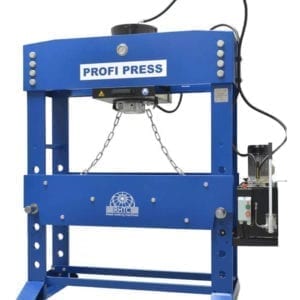
160 TON M/H-M/C-2 Motorised Hydraulic Workshop Press
Please contact for prices- Movable Cylinder
- Working Width: 1100 mm
- Stroke: 400 mm
- Motorised/Hand
- EU Built/CE Certified
-
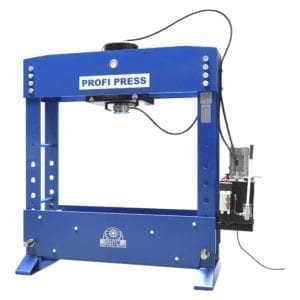
160 TON M/H-M/C-2 D=1500 Motorised Hydraulic Press
Please contact for prices- Movable Cylinder
- Working Width: 1500 mm
- Stroke: 400 mm
- Motorised/Hand
- EU Built/CE Certified
-
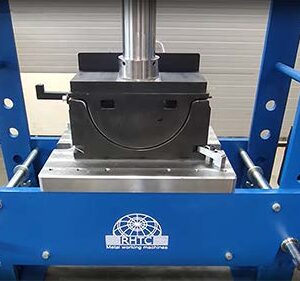
Workshop Press • 160 Ton Customised • Pipe Bracket Bender
Please contact for prices- Bespoke Configuration
- Pipe Bending Tooling
- Broad Range of Tonnages
- Bespoke Tooling Available
- EU Built/CE Certified
-

150 Ton Four-Column Hydraulic Production Press • MV-150NC
Please contact for prices- 1050 × 950 mm tables
- 450 mm ram stroke
- 700 mm vertical daylight
- Siemens touchscreen controls
- Frequency inverter control
-

Folding • Double-Column Hydraulic Press • 150 Tons • FDM-150E/3000
Please contact for prices- 150 Tons Capacity
- Designed for Folding
- 250 mm Piston Stroke
- Siemens PLC & Touchscreen
- 300 Stored Programs
-

Rotor and Stator Stacking • Double-Column Hydraulic Press • 150 Ton • FDL-150-100E/NC
Please contact for prices- 150 Tons Capacity
- 100 Tons Shaft Extraction Cylinder
- Movable Table
- Siemens PLC – Touchscreen
- Manual/Automatic Operation
-

VULCANISATION – FDV-125E – Bespoke Double Column Press – 125 Tons
Please contact for prices- 125 Ton Capacity
- 1350 × 1100mm Heated Tables
- Hydraulically Extractable Lower Table
- 250mm Stroke
- Two-speed Hydraulic System
-

Portal Straightening Press • 150 Ton • Manual Gantry • ST-150
Please contact for prices- 150 Tons Capacity
- Manual Gantry Movement
- Manual Lateral Head Movement
- Double Acting Hydraulic Cylinder
- Motorised Hydraulic Power Unit
-

150 Ton C-Frame Hydraulic Press with Upper Moving Table • CM-150NC
Please contact for prices- Upper moving T-slot table
- Fixed lower T-slot table
- Guided upper table with Ø50mm columns
- 4″ Siemens foot-pedal touchscreen
- Type 4 PLe safety light curtains
-

Cambering and Straightening Press • 150 Ton • SH-150 • Hidrogarne
Please contact for prices- 150 Ton Capacity
- Horizontal Hydraulic Ram
- Lever Operated Cylinder Control
- Height Adjustable Support Rollers
- Two Speed Hydraulic Power Unit
-

Double Column Mechanical Presses • Series PMF • 125 to 400 Tons
Please contact for prices- 125 To 400 Tons Capacity
- Fixed Stroke
- 6 Guided Ram
- Automatic Ram Adjustment
- Hydraulic Overload Protection
-

Double Column Mechanical Presses • Series PMV • 125 to 400 Tons
Please contact for prices- 125 To 400 Tons Capacity
- Variable Stroke
- 6 Guided Ram
- Automatic Ram Adjustment
- Hydraulic Overload Protection
-

150 Ton High-Speed C-Frame Hydraulic Press • CF-150VR
Please contact for prices- Upper and lower T-slot tables
- 450mm ram stroke
- 7″ Siemens orientable touchscreen
- Rapid approach and return cylinders
- Type 4 PLe safety light curtains
-
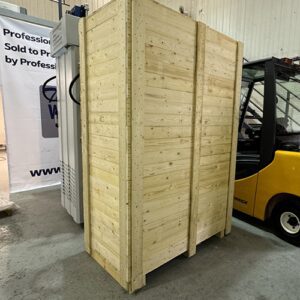
Crating for Export of Machinery by Sea or Air
Please contact for prices- Crating for Sea and Air Shipments
- Any Machine Can Be Shipped
- ISPM 15 Certification
- Enhanced Build Strength
- Global Compliance
-

Front to Back Service
Please contact for prices- Delivery
- Offloading and Placement
- Levelling
- Mains Connection
- Training and Certification
-
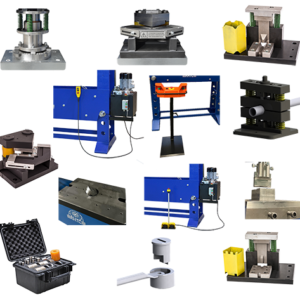
Hydraulic Press Accessories & Tooling Solutions for Precision Metalworking
Please contact for prices- V-Blocks and Tables
- Hand/Foot Controls
- Notching & Rounding Tools
- Tube Notching
- Digital Pressure Gauges
What Characteristics define a Hydraulic Press?
Let’s first define the term “Hydraulic Press”.
According to Merriam-Webster a hydraulic press is: a machine in which great force with slow motion is communicated to a large plunger by means of liquid force into the cylinder in which it moves by a piston pump of small diameter to which the power is applied
By all standard terms a hydraulic press has a frame, a hydraulic cylinder, a power pack or a pumping system, and a mechanism to control the power pack whether it be manual or electronically based.
The very first thing people talk about when discussing a hydraulic press is its Tonnage, and the tonnage of a hydraulic press typically ranges from 5 tons up to 5000 tons. In order to deliver the tonnage a Hydraulic Cylinder is needed, and the many different types of hydraulic cylinders is a complete topic on its own. Most importantly, all the presses that The Workshop Press Company offers are dual-action cylinders which means that hydraulic oil is delivered to both sides of the cylinder platen and which side the oil is delivered to is a matter of what side the controls are telling the power pack to deliver it to. In most situations, the larder the cylinder is, the more pressure it can deliver. There are other factors that can be introduced into the equation such as system pressure and oil delivery rate, but we are talking general terms now.
One of the other factors that defines the category of a hydraulic press is its Framework. The Workshop Press Company offers a variety of hydraulic presses, and the categories are Workshop Presses or H-Frame Presses, C-Frame Presses, Deep Drawing Presses, Four Column Presses, Portal Presses, and Production Presses. The details of the presses can be acquired in each product category on our site.
Other features that define a hydraulic press are the presses the size of the motor driving the hydraulic pump and it is defined in kilowatts. The Throat Depth which is the distance from the very front of the opening of the press to the back of the press and it defines how deep you can put a workpiece into the press. The Advance Speed which is how fast the cylinder advances until it switches into Working Speed, with Working Speed being slower than the Advance Speed. The Return Speed is how fast the cylinder returns after the define stroke or cycle is completed. System Pressure is defined in bar and most basic systems have a System Pressure around 300 bar. Piston stroke defines how far the piston can travel and this is defined by the overall size of the cylinder and piston. Some presses have Guides that assist in keeping the Slide Table perfectly square to the Bolster Table, and the larger the diameter is the more rigid the guides will be. The top table (Slide) and bottom table (Bolster) are defined by Length and Width and often times a thickness dimension will be included in defining the tables. The Daylight of a press defines what the maximum opening is from the Slide Table in its upmost position to the Bolster Table with the Bolster table being the static table. The Working Height of a press defines how hight the Bolster Table is from the floor. And finally there is the presses Length, Width, Height, and Weight. It is a generally accepted concept that the heavier the press is, the more rigid it is, but without question there are other factors that enter into that equation.
All these facts, figures, numbers, and parameters can be confusing so let the qualified people at The Workshop Press Company assist in determining the correct press for your application. Contact us on 0800 999 1090 or info@workshoppress.co.uk.