
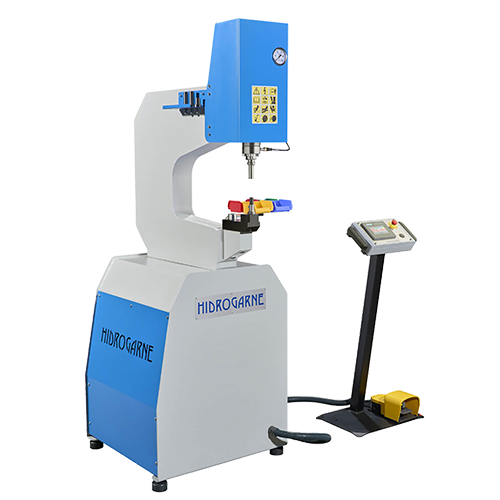
The Workshop Press Company supplies hydraulic fastener insertion and clinching machines in 6, 10 and 15-tonne capacities, with analogue and NC digital control options.
These machines support inserting and clinching applications, and we have also carried out riveting operations using suitable tooling. The right configuration depends on the component, material, fastener and production requirements.
This guide explains the processes, the features available within our machine range and the information we need to help you select a suitable setup.
What is a fastener insertion machine?
A fastener insertion machine uses controlled pressing force to install a fastener into a component. Typical fastener insertion applications include fitting self-clinching nuts, studs and standoffs into sheet metal.
These fasteners provide attachment points for subsequent assembly. The required hole preparation, installation force and supporting tooling depend on the fastener and sheet material.
Our hydraulic machines are designed for inserting operations. Send us your fastener specification and component details so we can assess the appropriate machine and tooling arrangement.
What is sheet metal clinching?
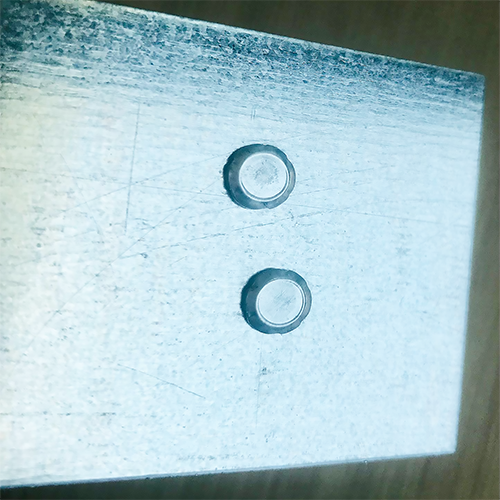
Clinching joins overlapping sheets by pressing them together between a specially shaped punch and die.
The tooling locally deforms the sheets to create a mechanical interlock. The joint is formed from the sheet material itself, without a separate rivet or welding heat.
It can be considered for brackets, panels, housings and other fabricated components where a permanent connection is required.
How does clinching differ from riveting?
Clinching creates the connection by forming the sheets themselves. Riveting uses a separate rivet to hold the components together.
Fastener insertion is another operation: it installs a fastening element, such as a nut or stud, into a component.
The joining process determines the tooling required. A setup selected for clinching should not be assumed suitable for inserting a fastener or setting a rivet.
Can your machines perform riveting?
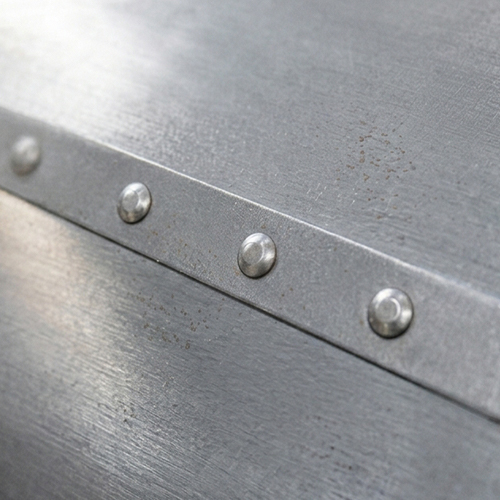
Yes. We have carried out riveting operations using this type of machine with suitable tooling.
The appropriate setup depends on the rivet type and size, material combination, component geometry and required joint finish. The upper tool and lower support must suit the operation and allow the component to be positioned correctly.
Send us the rivet specification and a drawing or sample of the assembly. We can then discuss the proposed process and tooling requirements.
Why consider clinching instead of welding or riveting?
Clinching provides a way to join suitable sheet materials without a separate rivet or welding heat. It may be useful where an additional fastener is undesirable or where a cold joining process is preferred.
It can also be considered for certain combinations of different metals, thicknesses and surface finishes.
The suitability of the process depends on the material’s ability to form, the punch-and-die combination and the joint requirements. Representative components should be assessed before selecting the production setup.
What materials are covered by your machine range?
The machine catalogue identifies copper, aluminium, carbon steel and stainless steel for inserting and clinching applications.
It gives a clinching thickness range of 1–6 mm. This is a specification for the range, rather than confirmation that every machine and tooling combination can join every material within those limits.
Please provide the material grade and thickness of each layer. For clinching, the complete material combination and its formability must be considered.
Can coated or different materials be joined?
As a general process, clinching may be suitable for coated sheets and combinations of different metals or thicknesses.
For an application on our machines, the proposed material combination, coating condition, tooling and required joint performance must be assessed together.
Tell us about galvanising, paint or other surface treatments when submitting your enquiry.
Which machine models and capacities are available?
The standard range comprises three capacities, each available in analogue and NC digital versions.
| Models | Capacity | Throat Depth | Adjustable Stroke |
|---|---|---|---|
| 60 ANALOG / 60 NC DIGITAL | 6 tonnes | 500 mm | 0–80 mm |
| 100 ANALOG / 100 NC DIGITAL | 10 tonnes | 650 mm | 0–80 mm |
| 150 ANALOG / 150 NC DIGITAL | 15 tonnes | 450 mm | 0–80 mm |
Pressing capacity and throat depth should be considered separately. The highest-capacity machine does not have the deepest throat, so selection must account for both the force required and access to the joining position.
What is throat depth, and why does it matter?
Throat depth is the reach between the tooling position and the machine frame. It affects how far a component can extend into the machine while the joint is aligned beneath the punch.
This matters when working with large panels, enclosures or joining positions away from an accessible edge. Folded flanges and other features may also restrict access around the tooling.
A drawing showing each joining position helps us assess the machine reach and tooling clearance required.
What do the analogue models provide?
The 60 ANALOG, 100 ANALOG and 150 ANALOG machines are intended for standard production applications and repetitive work.
The catalogue specifies manual pressure regulation and adjustable punch return stroke. These allow the operator to set the pressing arrangement for the proposed operation.
The analogue models also incorporate a dual integrated safety system and operation through a dual electric safety pedal.
What additional controls do the NC digital models provide?
The 60 NC DIGITAL, 100 NC DIGITAL and 150 NC DIGITAL machines provide additional process adjustment through integrated software and a 4-inch touchscreen.
The catalogue specifies:
- A preloaded and updatable library of inserts and working forces.
- Electronic adjustment of pressing time from 0–5 seconds.
- Punch stroke control.
- A dual integrated safety system.
- A distance sensor on the punch holder.
- Operation through a dual electric safety pedal.
The digital controls are worth considering where additional adjustment is required or where different components and inserts are processed on the same machine.
What does the punch and tool holder do?
The upper tool holder secures the tooling through which the pressing force is applied. The lower tooling supports the component or fastener and provides the opposing surface needed for the operation.
For clinching, the punch and die form the joint together. For inserting and riveting, the tooling must suit the particular fastener or rivet and support the component correctly.
Alignment, clearance and support are important. Sufficient pressing capacity alone does not establish that a machine is correctly configured for an application.
How does the upper punch-holder safety mechanism work?
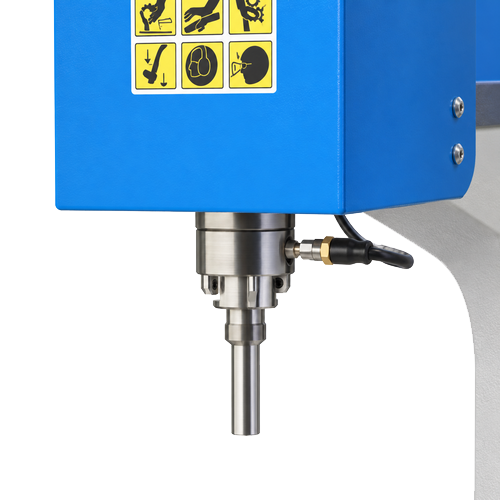
The sensor-equipped assembly uses a vertically moving barrel monitored by a movement sensor. If the barrel moves beyond its permitted vertical travel, the sensor activates and stops the machine cycle.
This monitors movement at the upper punch-holder assembly, close to the pressing operation. Correct setup, adjustment and maintenance are important for the mechanism to operate as intended.
The catalogue explicitly identifies a punch-holder sensor on the NC digital versions. Please contact us to confirm the safety configuration on the particular machine being specified.
What other safety arrangements should be considered?
The catalogue describes a dual integrated safety system and operation through a dual electric safety pedal for both analogue and digital versions.
The complete arrangement should be considered alongside the tooling, component support, operator access and loading and unloading method. The punch-holder mechanism forms part of the protection provided; it does not replace suitable tooling, operator training or safe working procedures.
We can discuss the documented safety features of the proposed machine and how they relate to your application.
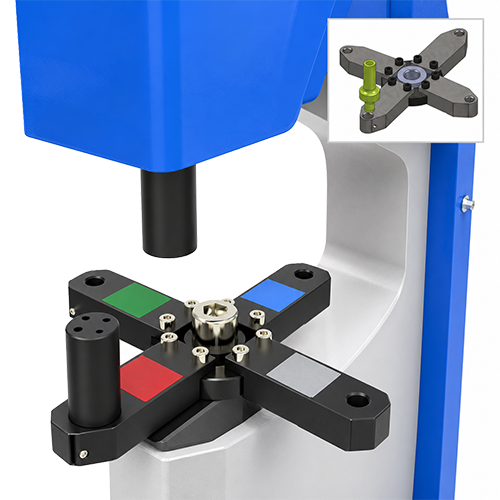
What is the optional four-station rotary indexer?
The rotary indexer, described in the catalogue as a four-station turret, provides four tooling positions within a rotary assembly.
The system includes automatic work-position detection and is listed as optional equipment for the NC digital models.
It is worth discussing where a component requires different tooling positions or fastener types. The tooling configuration and operating sequence should be agreed for the proposed work.
The catalogue confirms automatic work-position detection; the indexing method and any requirements for automatic rotation should be confirmed when specifying the machine.
What optional equipment is available?
The catalogue lists the following options:
- High-efficiency inverter system with start-stop operation.
- Laser pointer.
- Brush table.
- Automatic insert feeding system for NC digital models.
- Four-station turret with automatic work-position detection for NC digital models.
The automatic insert feeder and four-station turret are not listed as options for the analogue machines. Contact us to discuss the equipment suitable for your model and application.
Can the tooling be matched to my component?
Tooling selection is central to specifying the application. Relevant details include the fastener or rivet, material thickness, joining position, flange geometry and access around the component.
The component must be supported appropriately during pressing, and there must be sufficient clearance to load, position and remove it.
Where necessary, representative samples and joining trials can help establish the proposed tooling and settings before a production arrangement is agreed.
How should the finished joint be assessed?
The checks depend on the purpose of the joint and the requirements of the component.
For fastener insertion, relevant checks may include seating, retention and resistance to rotation. For clinching and riveting, joint appearance and mechanical testing may be appropriate.
The required acceptance criteria should be agreed for the application. A visually neat joint alone does not establish its suitability for the intended load or service conditions.
What information should I send for a quotation?
Please provide as much of the following information as possible:
- A component drawing or clear photographs.
- Material grade and thickness of each layer.
- Fastener or rivet specifications, where applicable.
- The position of each joint.
- Access restrictions, folded flanges or other clearance considerations.
- Required production rate and typical batch sizes.
- Any joint testing, inspection or finish requirements.
If you are unsure which joining process is appropriate, show us the component and explain what the finished assembly needs to achieve.
Discuss Your Fastener Insertion, Clinching or Riveting Application
The Workshop Press Company can help you assess the machine capacity, reach, controls and tooling required for your component.
Call:
0800 999 1090
Email:
info@workshoppress.co.uk
Send us your drawing, photographs or sample details to start the discussion.